Have You Checked Your Pockets Lately?
Let’s talk about why you turn on your burners for production in the first place. It’s to make money. You wouldn’t be there each and every day if it wasn’t for that simple truth. You’re in business to make money, to make a living and grow your business. If your business isn’t profitable, then you won’t be around for very long.
You purchase fuel (usually natural gas from a utility) to heat your process. That’s money out of your pocket. The Burner is the mechanical device that blends Air (containing Oxygen),with the fuel, ignites the mix and produces a controlled stable flame and heat. So, maintaining proper burner operation to get maximum available heat out of the gas you paid for is a pretty big deal! The mass (weight) or volume proportion of combustion air to the natural gas is referred to as the Air-Fuel Ratio or sometimes just Ratio. The ideal theoretical ratio for complete combustion is approximately 10 parts air to 1 part fuel (natural gas) by volume or 10:1. If we measure it in Mass, It’s about 17 parts air to 1 part fuel (natural gas). This ratio is referred to as “Stoichiometric Combustion” or often called “Perfect Combustion”.
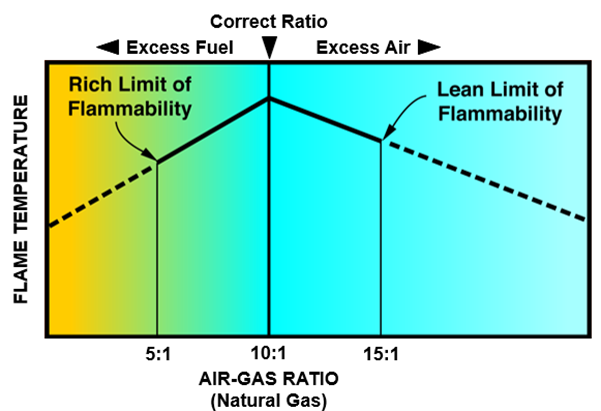
By volume, a higher ratio (say 12:1) is called a “lean” mixture (excess air). A lower ratio (say 8:1) is called a “rich” mixture (insufficient air). Either way, the flame becomes colder and can produce unburned fuel in the form of CO as well as pollutants such as NOx or Aldehydes. There is a limit to how far we can go with excess air or insufficient air before we no longer can support combustion. That’s called the “Limits of Flammability” , a minimum of 5:1 to a Maximum of 15:1 for Air-Fuel Ratio. It’s all about temperature.
Now a lot depends on the heat process to determine how we set up the burner. In most cases, it is difficult at best for burners to achieve perfect combustion. So, we sort of hedge our bets a bit by adding extra air to the mix, just to be sure we have complete combustion.
Remember, it is the Oxygen in the Air that is needed for combustion. If we had pure Oxygen alone instead of air, we would only need 2 parts O2 (Oxygen) to 1 part Gas. The ratio would be 2:1 instead of 10:1 like we need when providing normal air. Why? Because air (the same air we breathe) has only about 21% Oxygen by volume, the rest is 78% Nitrogen, and other gases make up the rest. We must add more volume of air to get the Oxygen we need.
So, what it all means is that too much, or not enough ratio costs money! That’s out of YOUR pocket!
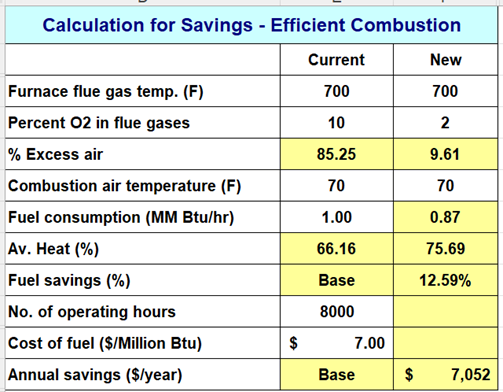
For example, we have a 1 million btu/hr. burner on an oven. It operates at 700F, continued process, with a cost averaging of gas at $5.00/million btu. If the burner was tuned to reduce the excess air from 10% O2 down to 2% O2 , 85.25% down to 9.6% excess air, this can result in a savings of over $5,000.00 annually. That’s money back in your pocket! May be worth checking your pockets and doing a little tuning on your combustion systems?
For more information about training or service needs, give Lee Gilbert a call (815)-299-8631
With this chart, note that the peak flame temperature is at the peak of Correct Ratio. As we move towards excess air (increased ratio), we see the flame temperature drop. If we move towards the excess fuel side of the peak (lower ratio), we again see the flame temperature drop. But with insufficient air we end up with possible soot. The minimum to maximum air-gas ratio range is 5:1 to 15:1 by volume. Any more or less in ratio will not support combustion. That’s referred to as “The Limits of Flammability”. It’s all about temperature.